
Somatic Healing in NYC: How to Regulate and Restore Your Nervous System in Practice
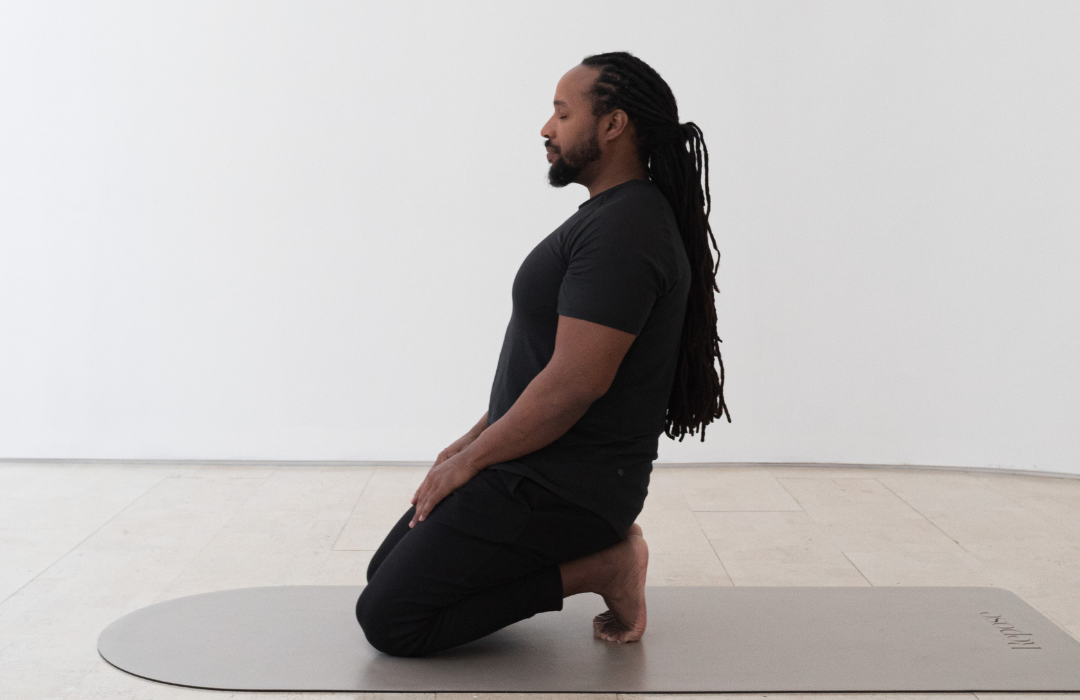
Somatic healing practice in a NYC studio with a man kneeling upright on a yoga mat, eyes closed and posture aligned, demonstrating nervous system regulation through breath and body awareness.
Somatic Healing in NYC: How to Regulate and Restore Your Nervous System in Practice
Living in New York means moving fast.
There’s always something to get to, something to respond to, something to keep up with. Over time, that pace can start to live in the body — not just as stress, but as a constant baseline.
You might notice it as:
difficulty slowing down
feeling wired but exhausted
tension that doesn’t fully release
a sense of being “on” all the time
This isn’t just mental. It’s physiological.
And it’s where somatic work becomes essential.
What It Means to Regulate the Nervous System
Your nervous system is constantly scanning for safety or threat.
When it perceives stress, it shifts into survival states like:
fight or flight (anxiety, urgency, restlessness)
freeze or shutdown (numbness, disconnection, fatigue)
These responses are not problems — they’re intelligent adaptations.
But when they become chronic, it can feel like you’re stuck in them.
Regulation isn’t about forcing calm.
It’s about helping the body move out of these states and return to balance.
Why Restoration Has to Be Felt, Not Forced
A lot of what we’re told about relaxation doesn’t actually work.
“Just take a break.”
“Try to calm down.”
“Stop overthinking.”
These approaches stay at the level of thought.
But the nervous system doesn’t regulate through logic — it regulates through experience.
That means:
sensing the body
noticing subtle shifts
allowing changes to happen gradually
This is why somatic work focuses less on doing more, and more on learning how to feel differently.
What Somatic Healing Looks Like in Practice
At its core, Somatic Experiencing® is about working in small, manageable steps.
Rather than revisiting overwhelming experiences all at once, the process emphasizes:
titration (touching into experiences slowly)
pendulation (moving between activation and safety)
resourcing (connecting to sensations of support and stability)
This helps the nervous system avoid overwhelm and instead build a sense of safety over time.
The goal isn’t to force release — it’s to allow the body to unwind at its own pace.
What This Looks Like in Practice
In a studio setting, somatic work is not about performance or intensity.
It’s about creating the conditions for the nervous system to settle and reorganize.
That might look like:
slow, intentional movement
guided awareness of internal sensation
moments of stillness and pause
gentle shifts between activation and rest
Rather than pushing limits, the focus is on building capacity — the ability to stay present with sensation without becoming overwhelmed.
Over time, this allows the body to:
release held tension
feel safer at rest
respond more flexibly to stress
Why This Matters in a City Like New York
In a fast-moving environment, the nervous system rarely gets a chance to fully reset.
Even moments of rest can feel incomplete — like you’re pausing, but not actually recovering.
Somatic practices offer something different.
They create space for the body to:
come out of constant activation
reconnect with a sense of grounding
experience what regulation actually feels like
This isn’t about escaping the pace of the city.
It’s about building resilience within it.
A Space to Practice, Not Just Understand
Understanding stress is one thing.
Being able to shift your state is another.
That shift happens through repetition — through giving the body consistent opportunities to experience regulation.
At Repose, our studio offerings are designed to support this process.
Each session is an opportunity to:
slow down in a structured, supported way
build awareness of your nervous system
practice moving between activation and rest
Not as a one-time reset, but as an ongoing skill.
Regulation Is Something You Can Learn
If your body feels stuck in stress, it doesn’t mean something is wrong.
It means your nervous system has adapted to what it’s been given.
Somatic work offers a way to gently shift those patterns — not by overriding them, but by working with them.
Over time, regulation becomes less of something you chase, and more of something your body knows how to return to.
→ Experience this work in practice through our Somatic Experiencing®–informed yoga class, offered Saturdays at our Union Square studio with Madeline Manning LMSW, SEP