
When You’re Carrying Generations at Once
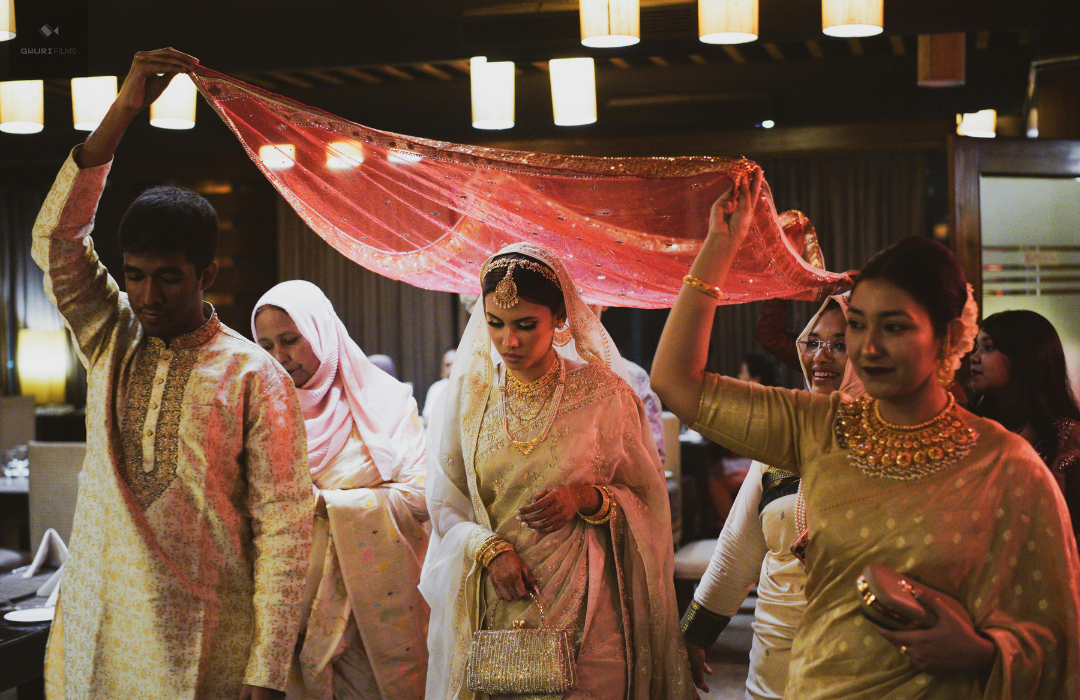
A bride in traditional South Asian attire walks solemnly beneath a red embroidered veil held by loved ones, surrounded by family members in a warmly lit indoor setting—capturing a moment of cultural ritual, support, and the quiet weight of generational legacy.
When You’re Carrying Generations at Once
For many South Asians, pressure doesn’t arrive loudly.
It arrives early.
In expectations you don’t remember choosing.
In responsibility that feels inherited.
In the quiet understanding that you are part of something bigger than yourself.
Family, culture, success, sacrifice — these aren’t abstract values. They’re lived realities that shape how emotions are handled, expressed, or postponed.
The Weight of “We Don’t Talk About That”
In many South Asian households, emotions are managed through endurance.
You push through.
You stay busy.
You don’t burden others with what you’re feeling.
Mental health struggles are often minimized — not out of cruelty, but survival. Previous generations didn’t have language or space for emotional processing.
The result is a generation that feels deeply — but often privately.
High Achievement, Low Permission to Rest
Many South Asian clients grow up with clear expectations:
succeed academically
be responsible
prioritize family
don’t fall behind
Achievement becomes safety. Productivity becomes worth.
But beneath the drive is often anxiety, burnout, or a constant sense of never quite doing enough.
Therapy helps untangle ambition from self-worth — without asking you to abandon your values. The Pressure to Perform Early
Many teens feel pressure to have things figured out too soon.
To be accomplished.
To be productive.
To manage stress like adults — without adult-level support.
Failure feels public. Mistakes feel permanent. Comparison feels constant.
Therapy offers a rare space where performance isn’t required.
The In-Between Identity
Many South Asians live between cultures.
Navigating Western independence alongside collectivist family values. Translating emotional needs across generations. Feeling “too much” in one space and “not enough” in another.
This in-between can feel isolating — especially when it seems like no one fully understands both sides.
Therapy offers a place where this duality doesn’t need to be explained or simplified.
Emotional Expression Isn’t Disrespect
One of the most common internal conflicts South Asian clients face is guilt around emotional expression.
Setting boundaries can feel like betrayal. Naming pain can feel ungrateful. Choosing yourself can feel selfish.
Therapy reframes emotional honesty not as disrespect — but as care.
Care for yourself. And often, for the relationships you’re trying to preserve.
What South Asian–Affirming Therapy Looks Like at Repose
Therapy for the South Asian community at Repose is culturally attuned, identity-aware, and nervous-system-informed.
Sessions may focus on:
navigating intergenerational dynamics
unpacking cultural pressure and expectation
regulating anxiety and burnout
exploring identity without guilt
learning how to set boundaries while staying connected
You don’t need to choose between culture and well-being here.
Both can coexist.
Healing Without Cutting Ties
Therapy doesn’t assume distance is the solution.
Sometimes it’s about clarity — understanding what’s yours to carry and what isn’t.
Healing can mean relating differently, not disappearing.
It can mean finding language for needs that were never modeled.
Making Space for Yourself Within the System
South Asian therapy is not about becoming less connected.
It’s about becoming more whole.
About honoring your history while creating space for your own emotional life — one that doesn’t require constant suppression.
You don’t have to hold everything alone.
→ Explore culturally responsive therapy for the South Asian community focused on identity, family dynamics, and emotional well-being at Repose.