
When Food Takes Up More Space Than It Should
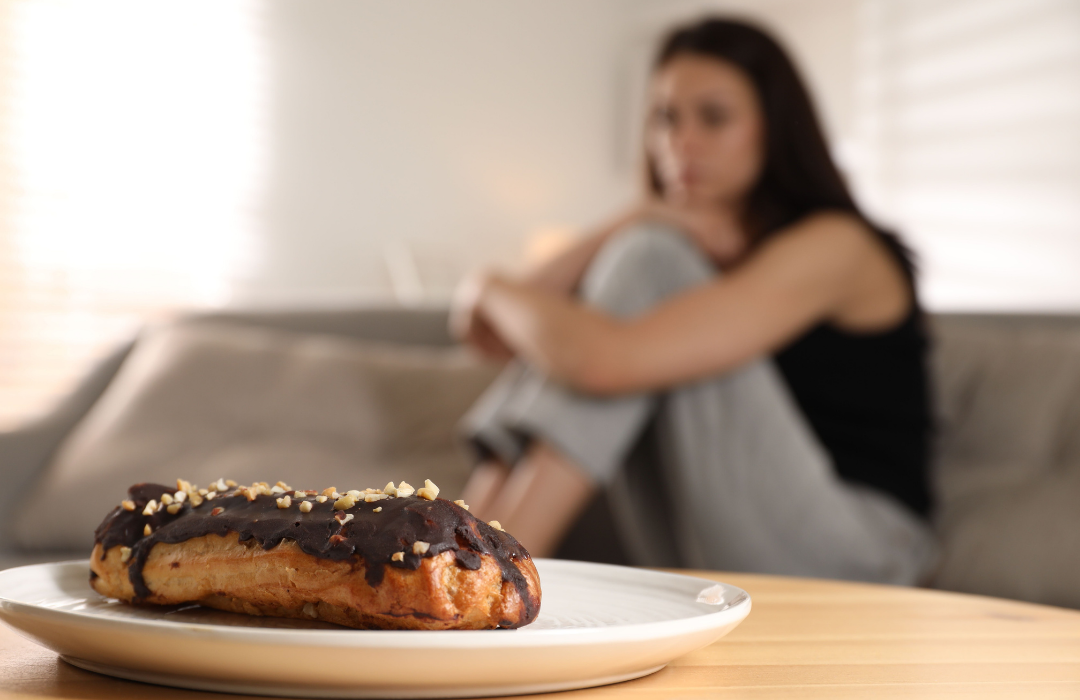
Chocolate pastry on a plate in the foreground while a person sits blurred in the background looking withdrawn, symbolizing emotional eating, food struggles, and the complex relationship between food and mental health.
When Food Takes Up More Space Than It Should
For many people, eating isn’t neutral.
It’s loaded. Strategic. Emotional. Moralized.
What should be simple becomes constant background noise — calculations, rules, guilt, restraint, compensation. Food becomes something to manage rather than experience.
This isn’t about willpower.
It’s about control, safety, and a nervous system trying to cope in a culture obsessed with bodies.
Disordered Eating Doesn’t Always Look Extreme
There’s a stereotype of what an eating disorder looks like.
But many people struggling don’t fit it.
They’re functional. Social. Successful. They eat — just not without stress.
Disordered eating often shows up as:
rigid food rules
anxiety around eating out or socially
cycles of restriction and loss of control
guilt after eating
constant body monitoring
using food to regulate emotion
It can be quiet. Invisible. Easy to normalize.
Until it isn’t.
The Wellness-to-Control Pipeline
Modern wellness culture blurs the line between care and control.
Clean eating. Tracking. Optimization. “Listening to your body” — often filtered through productivity and perfectionism.
For many people, these messages don’t lead to health.
They lead to hypervigilance.
Eating disorder therapy helps untangle what’s actually supportive — and what’s keeping you stuck in a cycle of monitoring and self-criticism.
This Isn’t About Food — It’s About Safety
Disordered eating is rarely about hunger.
It’s about:
regulating emotion
creating predictability
managing anxiety
feeling in control when life feels overwhelming
Food becomes a coping mechanism — not because you’re broken, but because it worked at some point.
Therapy helps your nervous system learn new ways to feel safe without relying on restriction or control.
What Eating Disorder Therapy Looks Like at Repose
Eating disorder therapy at Repose is nonjudgmental, body-respectful, and nervous-system-informed.
There’s no shaming. No forcing. No pressure to “fix” yourself quickly.
Sessions may focus on:
understanding emotional patterns around food
reducing food-related anxiety and guilt
rebuilding trust with hunger and fullness cues
exploring control, perfectionism, and self-worth
supporting regulation without using food as the primary tool
This work is slow — intentionally.
Because safety can’t be rushed.
Healing Is Not Linear (or Aesthetic)
Recovery doesn’t look clean.
It doesn’t move in a straight line.
It doesn’t always feel empowering.
It often feels disorienting at first.
Letting go of food rules can feel like losing control before it feels like freedom.
Therapy provides a container for that in-between space.
A Relationship With Food That Takes Up Less Space
Healing doesn’t mean food becomes joyful all the time.
It means food becomes quieter.
Less charged. Less central. Less controlling.
Eating disorder therapy supports a life where food no longer dictates your mood, worth, or sense of safety.
You don’t need to earn nourishment.
You deserve it — without conditions.
→ Explore eating disorder therapy grounded in nervous system support and body respect at Repose.